

MIDI Moheshkhali–Matarbari
fossil-fuel mega project
Japan is bankrolling a fossil fuel megaproject Bangladesh can't afford
The Moheshkhali–Matarbari Integrated Infrastructure Development Initiative (MIDI) locks in up to 13 gigawatts of new LNG power and a coal plant on a fragile, climate-vulnerable coast at the very moment renewables are becoming the cheaper option.
Call on companies behind MIDI to choose renewables.
MIDI video
The fossil fuel projects: what MIDI would actually build
Polluting fossil fuels is the core of Japan’s MIDI megaproject.
- 13 GW of new liquefied natural gas (LNG) power: JICA's master plan proposes up to 13 GW of new LNG-fired power generation in the Chattogram region.
- A new land-based or onshore LNG terminal with 1,000 million cubic feet per day capacity.
- Ammonia and hydrogen "transition fuels” that don't add up: The MIDI plan proposed adoption of ammonia and hydrogen co-firing as a future fix for emission reduction in Bangladesh’s energy mix. Grey ammonia made from fossil fuels carries lifecycle emissions roughly twice those of burning coal directly, and that co-firing is estimated to cost around four times more than renewables paired with batteries. Blue hydrogen, also made from fossil gas, is no better or cleaner than simply burning fossil fuels.
MIDI will backtrack global climate goals
- Why MIDI's LNG projects conflict with the Paris Agreement: The newly proposed LNG power projects in MIDI are built on inflated demand forecasts and are inconsistent with the 1.5°C goal of the Paris Agreement.
- MIDI’s 2070 net zero goal is too late for a climate-vulnerable Bangladesh: JICA's recommended scenario assumes Bangladesh reaches net zero only around 2070, with fossil fuels still supplying about 60% of power in 2050, a pathway that is also contradictory to Japan's own G7 commitment to end new public finance for unabated fossil fuels.
A devastating blow on local community
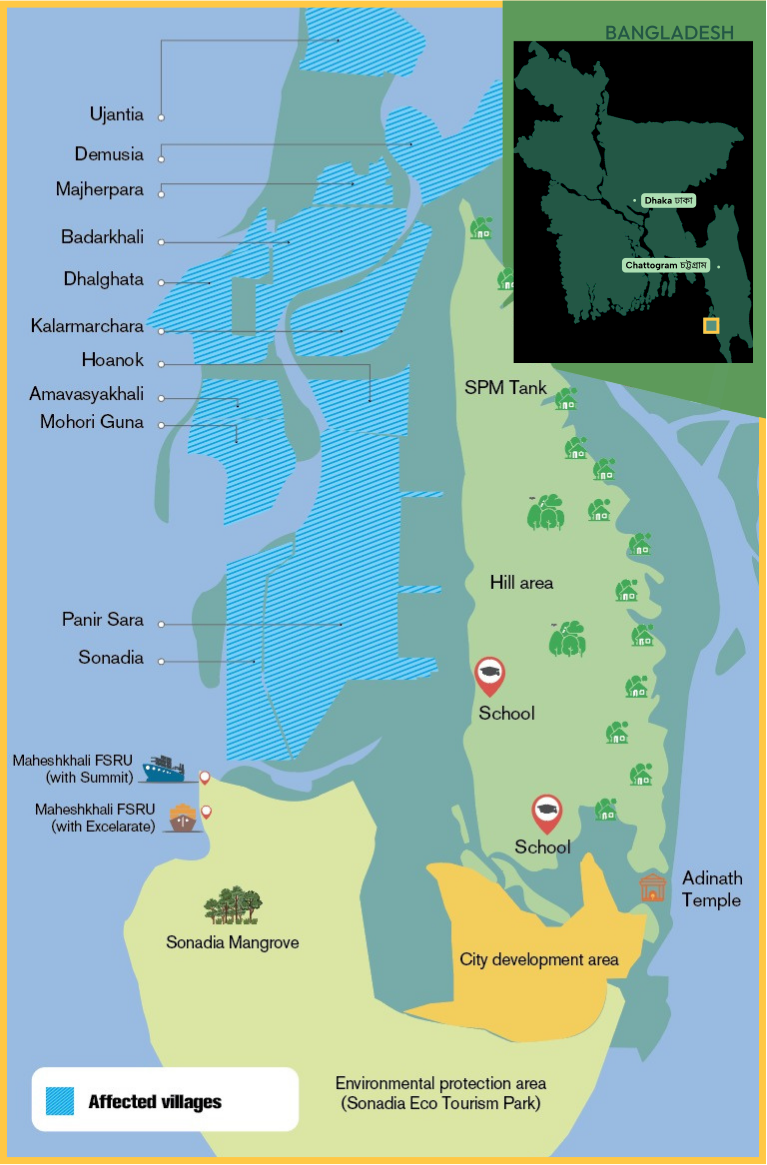
- MIDI plans require an estimated 73,000 acres of land. People in the following communities will likely be displaced and lose homes, businesses, schools, jobs and livelihoods:
- Dhalghata, Panir Sara, Mohori Guna, Matarbari, Uttar Nalbila, Kaliganj, Kalarmarchara, Hoanok, Amavasyakhali and Moheshkhali.
- Between 100,000 to 776,000 people potentially displaced. As seen with Matarbari 1, entire communities are likely to be forcibly removed from their homes and property, and the loss of livelihoods, businesses, schools, mosques and burial grounds. No known social impact assessment was completed for the MIDI plan as of June 2026.
- Loss of traditional livelihoods. The people of Matarbari and Moheshkhali rely on salt and shrimp farming, as well as other forms of crop farming and fishing from the nearby rivers and Bay of Bengal. During the construction of Matarbari 1, thousands of people lost their livelihood, and many did not receive full compensation.
MIDI, explained (FAQs)
What is the Moheshkhali–Matarbari Integrated Infrastructure Development Initiative (MIDI)?
MIDI is a Japan-backed industrial and energy megaproject on the coast of Bangladesh, coordinated by JICA. Its master plan covers about thousands of acres of land across Moheshkhali and Matarbari in coastal Chattogram, and centres up to 13 GW of new LNG-fired power and other industrial plans.
Who is leading MIDI?
Who is financing MIDI?
Why is MIDI's LNG expansion a financial risk?
Is renewable energy cheaper than LNG in Bangladesh?
Why should Japan and its companies invest in renewables instead?
View sources
- BloombergNEF, "Solar Soon to be the Most Affordable Electricity Source for Bangladesh," 2025. https://about.bnef.com/insights/clean-energy/solar-soon-to-be-the-most-affordable-electricity-source-for-bangladesh-report/
- Centre for Research on Energy and Clean Air (CREA), air-quality implications of coal–ammonia co-firing (cited in JACSES MIDI report). https://energyandcleanair.org/publication/air-quality-implications-of-coal-ammonia-co-firing/
- CLEAN, MIDI Master Plan, 2025. https://www.cleanbd.org/_files/ugd/1e88d4_be170a7d2bbe450bb25a3cb5b58f3e9f.pdf
- Dhaka Tribune, "Japanese influence over Bangladesh's Power Master Plan scrutinized at energy prosperity conference," Dec 2024. https://www.dhakatribune.com/bangladesh/power-energy/367972/
- Ember, "Spot market LNG purchases can cost Bangladesh about $11 billion between 2022 & 2024," 2024. https://ember-energy.org/latest-insights/spot-market-lng-purchases-can-cost-bangladesh-about-11-billion-between-2022-2024/
- Energy Tracker Asia, "The Solar and Wind Power Potential in Bangladesh." https://energytracker.asia/solar-and-wind-power-potential-in-bangladesh/
- Gas Outlook, "MIDI: Bangladesh's ambitious, controversial coastal venture," Feb 2026. https://gasoutlook.com/analysis/midi-bangladeshs-ambitious-controversial-coastal-venture/
- IEEFA, "Navigating Bangladesh's energy trilemma" (new Renewable Energy Policy, June 2025). https://ieefa.org/resources/navigating-bangladeshs-energy-trilemma
- JACSES / Fair Finance Guide Japan, "JICA support for 13GW LNG power expansion in Bangladesh — MIDI Masterplan inconsistent with the Paris Agreement," Sep 2025. https://jacses.org/en/wp-content/uploads/2025/09/EN_-MIDI-report.pdf
- JACSES, "JICA supported energy master plan in Bangladesh, soaked in fossil fuels and not aligned with the Paris Agreement," 2023. https://jacses.org/en/395/
- JACSES, Friends of the Earth Japan & Mekong Watch, joint statement on JICA loan disbursement and Matarbari corruption case, May 2025. https://jacses.org/en/592/
- JICA, MIDI – Strategic Vision and Economic Impact, 2023. https://openjicareport.jica.go.jp/pdf/1000050277.pdf
- MarineLink, "Bangladesh's ambitious wind energy plans are slow to progress," Apr 2026. https://www.marinelink.com/blogs/blog/bangladeshs-ambitious-wind-energy-plans-are-slow-to-progress-104638
- Market Forces, Expensive LNG Expansion: How foreign gas interests are a climate disaster for Bangladesh, 2024. https://fossilfreechattogram.com/Bangladesh-LNG-Report-2024-English-Full-Report
- Market Forces, MIDI Fact Sheet, 2023. https://fossilfreechattogram.com/wp-content/uploads/2023/10/English_Factsheet_MIDI.pdf
- Oil Change International, "'We cannot go to the sea now.' Massive Japanese fossil fuel project destroys Bangladeshi communities and worsens climate crisis," Dec 2025. https://oilchange.org/blogs/we-cannot-go-to-the-sea-now/
- Zero Carbon Analytics, "Bangladesh's reliance on LNG increases financial, energy and climate risks," 2025. https://zerocarbon-analytics.org/energy/bangladeshs-reliance-on-lng-increases-financial-energy-and-climate-risks/
This map shows the area MIDI will impact in the Chattogram region
Let’s make Chattogram fossil-free!
Protect Chattogram by sending a message to JICA, JERA, Sumitomo and others. These companies can finance renewables instead of fossil gas and LNG to transform Bangladesh's power system while protecting communities, biodiversity and the economy.
Expensive LNG Expansion: How foreign gas interests are a climate disaster for Bangladesh
November 2024
Bangladesh is facing an energy crisis, having suffered repeated blackouts caused by an increasing over-reliance on expensive and polluting fossil gas imports.
Rather than decreasing dependence on volatile international fossil fuel markets, and prioritising clean domestic renewable energy, Bangladesh is being pushed by foreign interests to double down on liquefied natural gas (LNG).
Bangladesh can choose a pathway with clean, green, renewable energy that will protect the environment and allow people to enjoy cheap, affordable electricity.